Thursday, February 28, 2013

For Briek's Sake

I am just reminded again of the awesomeness of Briek Schotte.

It is so much so that 't Gaverhopke Brewery released a limited edition Koerseklakske.


If you don't know Briek, all you need to know is here:

I can tell you more about "de Briek" lunch menu at the cafe near the museum of de Ronde in Oudenaarde, it is simple pasta with brown sugar and nothing more. 

Briek died in 2004 on the day de Ronde was won by a German, in front of two Belgians! By eyewitness account, winner Stefan Wesseman's wife was sitting in a cafe/bar in Oudenaarde when this happened. The Belgian crowd boasted that the race was won when two Belgians and a German entered the finale together. As the German winner crossed the finish line first, the crowd grew hushed, the silence so deafening that Wesemann's wife left the bar in awkwardness. 

Damn, Briek must have died heartbroken. 

Lieve Vlaanderen! 

(*) Koerseklakske refers to the leather helmet cyclists had to wear in Belgium well before helmet rules were widespread. 

Thursday, February 21, 2013

Tour Down Under, Tour of Qatar, and the early season to de Omloop

Fans of the classics: as if the snow blanket of winter had lured us to complacency, the Omloop Het Nieuwsblad (OHN) is nearly upon us already. Hailed as the opener of the Belgian classics races (some other nations have had their opening races by then), we wonder the impact of emerging early season races in warmer climates on the OHN. More specifically, we wish to compare the importance of Tour of Qatar (ToQ) and Australia's Tour Down Under (TDU) on the performance of classics warriors who have done well in the OHN.

In order to do this, we made a list of wielrenners who finished in the top 5 of the OHN from 2008 to 2012 and empirically compute the correlation of their performance and their attendance at the TDU and ToQ. What are we able to find out? Read on.


Thursday, January 17, 2013

Belgian Succession

It is hard to believe, but Tom Boonen is aging. The Belgian boy wonder from east and north of Antwerp is already 32 years old, he may be at the peak of his prowess but he's ridden for 11 seasons. Just like his former mentor and teammate Johan Museeuw - whose career overlapped with Boonen's in near-perfect synchronous sequence - Boonen has become a much more focused rider than he was in his younger days. The overlap between the aging Museeuw and then-surging Boonen spoiled us fans in more ways than we realized then. We never had to look for a Belgian hero of the cobbled classics, for a new Lion of Flanders.

Tom Boonen in 2012, from Creative Commons under license CC BY-SA 2.0,
photo taken by Angelo Giangregorio.

This natural succession also benefited Patrick Lefevere's QuickStep team, who always had a popular icon to stand behind. Even in Boonen's leanest years of 2010 and 2011, when he merely won  Gent-Wevelgem and merely reached the podium in both editions of de Ronde. As we know, cycling is a team sport, therefore having such icons as Museeuw and Boonen helped the team secure sponsorship which in turn enabled the retainment of a royal retinue, a merry band of Belgians and Italians whose job security and raison d'etre revolved around those few sacred weeks in April.

Who shall succeed Tom Boonen as the Belgian kaseinfretter?

Tuesday, January 8, 2013

Can Old Dogs Learn New Tricks?

Several retired pros have gone on to have illustrious careers as team coaches and directeurs sportif (DS). Raphael Geminiani comes to mind: as a rider he won the King of Mountains jerseys in the 1951 Tour de France and Giro d'Italia, yet he is perhaps best remembered as the DS and team manager of the mercurial Jacques Anquetil. Not only was he the DS who could manage the tempestuous Anquetil to incredible feats, he was a business innovator who side-stepped restrictions on team sponsorship.


Monday, November 19, 2012

Classics talents and the grand tours

To lovers of the classics, one of the most frustrating aspect of being a fan is that we have to watch promising classics talents waste their potential by foregoing the classics in pursuit of General Classification (GC) glory in the grand tours. Countless riders have fallen into this pitfall, sacrificing their huge classics potential yet not quite succeeding in the grand tours.

With specialization become both more prevalent and deeper in recent years, we consider some active riders of today.


Tuesday, November 13, 2012

Patrick Lefevere and the Yellow Jersey: Unconsummated Lust

As the boss of OmegaPharma-QuickStep, and with his history in MG-GB, Mapei, and Domo-Farm Frites, it can be argued that Patrick Lefevere is one of the most successful among modern cycling managers. His riders have won every classic at least once, and their domination of the spring classics is so complete that longtime fans rue that too much time has past since his team's last 1-2-3 win in Paris-Roubaix. Add to this multiple World Cup wins, World Championships, and stage wins / jersey wins in the grand tours.

Patrick Lefevere, from Wikipedia Commons.

One glaring omission is that Patrick Lefevere has never won the general classification (GC) of the Tour de France (TdF). In this article we recall his various attempts to buy, grow, cajole GC champions for the TdF.


Wednesday, October 17, 2012

Champions in a Brawl

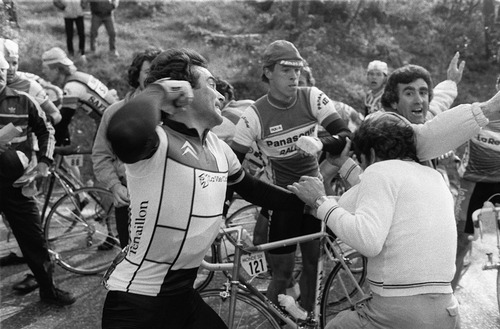
As the off-season of road cycling is suddenly upon us, our Classiciens ponder: How would cycling champions fare in a no-holds-barred brawl in a bar in Belgium? We celebrate the heroics of our hardmen on the bike, but who would they do in real-life situations that we Classiciens may have found ourselves in, once or twice?

Since much of this philosophical discourse is, well, philosophical and full of conjecture, we mix heroes of the old times, the not-so-old times, and of recent times. We start with a hypothetical bar, let's say at the foot of the Kappelmuur in Geraardsbergen, in the dead middle of February when snow and frost are still on the ground, and add a hypothetical cast of Henri Pelissier, Briek Schotte, Bartali and Coppi, Jacques Anquetil, Eddy Merckx, Freddy Maertens, Bernard Hinault, and of course Greg LeMond.

Bernard Hinault - aka The Badger - demonstrating the usefulness of street fighting skills in Paris-Nice.