Showing posts with label general. Show all posts

Thursday, August 16, 2012

La Vuelta a España, La Vuelta Desamado

La Vuelta a España, le Tour d'Espagne, the Tour of Spain, may be the least loved of the Grand Tours. After decades of directly competing with the Giro d'Italia - both races used to run at approximately the same time in spring - it moved to its current schedule in September in 1995. The new schedule made it an important race for many classics warriors who use it as a warm-up for the World Championship in October. But it also all but pushed it off the calendar of many General Classification (GC) contenders who already met their goals for the year. In a way, it became a race for GC contenders who were either left off the Giro d'Italia and Tour de France for various reasons and wanted a last chance to prove themselves.


History has made the case for us: many winners of the Vuelta don't even come back the following year to defend their title, if they showed up at all. We note the loyalty of Tony Rominger and Alex Zülle who are repeat winners, and recently Vicenzo Nibali who returned to try and defend his victory. To be fair, one can argue that Nibali had to target the Vuelta defense because he was crowded out of his own team who chose Ivan Basso to lead the Giro and the Tour that year.


Tuesday, April 24, 2012

Barely South of the Border

Not too long ago, nearly a lifetime ago, I took advantage of a work assignment to Paris and visited the beautiful pavés of the north. There, I was shown around by my friend Laurent and his dog Thibal, a local of Lille and very proud to be a Ch'ti.

We saw monuments, and the old citadel of Lille, and fortresses of Vauban, and even had home-made croissant which was amazing. We were on our way to a café for frites, when lo and behold: a bicycle race! We stopped the car immediately.

Secteur Pavés Gilbert Duclosse-Lasalle.

Tuesday, February 14, 2012

Rise of Nations

Just like in geopolitics, nations rise and fall as they contend in professional cycling. With the call for more and more globalization of pro cycling, we ask the question: what of the "old" nations and what of the "new emerging" nations?

In this article we use basic analysis tools to examine the rise and fall of nations in one-day racing. To be more precise, we consider Monuments and World Championship (WC) wins of Italy, Belgium, and France, versus those of "other nations." We use a moving-average of 7 years, which we consider the typical "mature and winning" period of a rider's career. We consider Milano-Sanremo, Ronde van Vlaanderen, Paris-Roubaix, Liège-Bastogne-Liège, Giro di Lombardia, Paris-Tours, and the World Championships.
What insights were we able to gleam? Read on ...

Wednesday, January 18, 2012

The Eve of OmegaPharma-QuickStep's Most Critical Season

Such is the weight of expectation on Belgian super-team QuickStep -- now called OmegaPharma-QuickStep -- that despite star Tom Boonen's convincing win in Gent Wevelgem its 2011 season was considered a failure. As the 2012 spring classics season approaches, we think that this will be their most critical season yet since the team's founding in 2001 as Domo-Farm Frites.

Tom Boonen and His Merry Band of Flemings, in better times.
For a team that specializes in, and has dominated, racing on pave for as long as most of us can remember, 2011's Paris-Roubaix was the first edition in which they failed to place a single rider in the top 10. Add to this a lethargic showing at the Tour de France, with no stage wins and no days in a leader's jersey.

What were the roots of QuickStep's lackluster 2011 performance? Here are our thoughts.


Tuesday, January 10, 2012

Method to the madness, or how I learned about the classics (part 2)

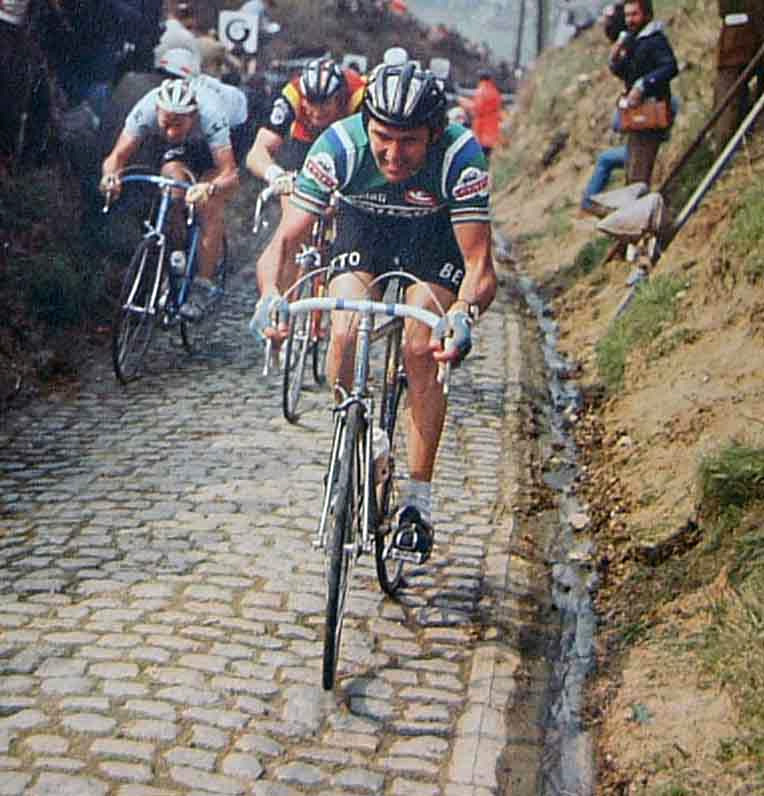
Gentle readers, in Part 1 we learned about Liège–Bastogne–Liège, la Flèche Wallonne, and Paris-Roubaix. We learned that as many of the cobbled roads were converted to asphalt, the so-called Ardennes Classics LBL and FW took on more and more hills, whereas PR the Queen of the Classics, not so blessed with available hills along its route, took on what cobbled sectors remained and even added more and more "new" ones with passing years. It time now then to talk about the Tour of Flanders, de Ronde van Vlaanderen, or Vlaanderen Mooiste. 


Photo from Wikipedia, Creative Commons License, due to Mick Knapton. 

Wednesday, January 4, 2012

Method to the madness, or how I learned about the classics (part 1)

Gentle readers, if you are reading this blog you are most likely already aware of what Paris-Roubaix is, perhaps of  Liège–Bastogne–Liège, and perhaps of the Tour of Flanders. But as soon as you delve a bit deeper beneath the icy surface of the Koppenberg, you find a whole other world of semi-classics such as Brabantse Pijl and Flèche Wallonne (which are really sister races, but that's another subject).


How does one possibly learn about these races, their significance, and how they relate to each other if one weren't born in a red barn-house in Belgium, and didn't learn to walk on Quick-Step laminated hardwood floors?

Allow us then to give a rambling tutorial of sorts, a story perhaps, of these races.

In the beginning, there were cobbles

In the beginning, there were cobbles. And hills. And often there were cobbled hills. Over time, some of these roads were converted into asphalt. But the legions of fans saw fit to preserve some of these cobbled stretches and climbs, or even to convert some roads back into a cobbled state of being.


Today we are merely 58 days from de Omloop Het Nieuwsblad, when the peloton shall rumble over the cobbles of the classic cycle races that we love. Call them the "classiques" if you speak French, or "klassieker" if you speak Flemish, or "classiche" if you prefer Italiano. But the season of our obsession is coming, and none too soon.