Showing posts with label legends. Show all posts

Tuesday, April 2, 2013

Age and the Classics Contender

When Fabian Cancellara, Peter Sagan, and Jurgen Roelandts ascended the Ronde van Vlaanderen (RVV) podium last Sunday, we thought that it represented three generations of cyclists. Cancellara (RadioShack) is today 32 years old, Sagan (Cannondale) merely 23 years old, and Roelandts (Lotto-Belisol) is 27 years old.

We ask ourselves: How do classics contenders age?

Naturally, we went to Cycling Archives and explored the wealth of data to compare several notable cyclists of various era, and compare them to more recent heroes.

What of older heroes?

Thinking about the RVV we certainly thought of Briek Schotte (born in 1919), twice winner of de Ronde and one of the original hardmen. We then thought of Eddy Merckx (born in 1945) and his impossibly long list of victories. We also thought of Roger de Vlaeminck (born in 1947), a rival of Merckx. And of course Bernard Hinault (born in 1954) of a slightly younger generation much like Cancellara and Sagan.

We then plotted our perception of their accomplishment in classics races, versus their age. What we found was interesting.


Tuesday, March 26, 2013

Super Mario in Gent-Wevelgem

Peter Sagan's charismatic win in Sunday's Gent-Wevelgem was superb, sign of a true champion who knows when to take charge and when to push for the win. While many expected him to wait for the final sprint, he put in more than his fair share in a break of 13 riders, and left them all in the dust by attacking away. In the end, he had a 23-second advantage in a race that had been threatened with cancellation just hours prior.

His win reminded us of "Super Mario" Cipollini's three wins in Gent-Wevelgem: in 1992, 1993, and 2002. His first win was perhaps the most amusing one (Watch video starting at 1:55). What was to be a formality -- a field sprint -- had "Tashkent Terror" Djamolidine Abdoujaparov pull on Cipollini's seat post as Cipo was surging past him. The tug was enough to push Abdou ahead of Cipollini, however Cipo kept his cool and raised his arms in celebration anyway.

"I knew he'd get penalized," he said calmly.


Cipo's 1993 win was straightforward: he simply hit the gas and sprinted literally from the front, nobody was able to get around him.


Thursday, February 28, 2013

For Briek's Sake

I am just reminded again of the awesomeness of Briek Schotte.

It is so much so that 't Gaverhopke Brewery released a limited edition Koerseklakske.


If you don't know Briek, all you need to know is here:

I can tell you more about "de Briek" lunch menu at the cafe near the museum of de Ronde in Oudenaarde, it is simple pasta with brown sugar and nothing more. 

Briek died in 2004 on the day de Ronde was won by a German, in front of two Belgians! By eyewitness account, winner Stefan Wesseman's wife was sitting in a cafe/bar in Oudenaarde when this happened. The Belgian crowd boasted that the race was won when two Belgians and a German entered the finale together. As the German winner crossed the finish line first, the crowd grew hushed, the silence so deafening that Wesemann's wife left the bar in awkwardness. 

Damn, Briek must have died heartbroken. 

Lieve Vlaanderen! 

(*) Koerseklakske refers to the leather helmet cyclists had to wear in Belgium well before helmet rules were widespread. 

Thursday, January 17, 2013

Belgian Succession

It is hard to believe, but Tom Boonen is aging. The Belgian boy wonder from east and north of Antwerp is already 32 years old, he may be at the peak of his prowess but he's ridden for 11 seasons. Just like his former mentor and teammate Johan Museeuw - whose career overlapped with Boonen's in near-perfect synchronous sequence - Boonen has become a much more focused rider than he was in his younger days. The overlap between the aging Museeuw and then-surging Boonen spoiled us fans in more ways than we realized then. We never had to look for a Belgian hero of the cobbled classics, for a new Lion of Flanders.

Tom Boonen in 2012, from Creative Commons under license CC BY-SA 2.0,
photo taken by Angelo Giangregorio.

This natural succession also benefited Patrick Lefevere's QuickStep team, who always had a popular icon to stand behind. Even in Boonen's leanest years of 2010 and 2011, when he merely won  Gent-Wevelgem and merely reached the podium in both editions of de Ronde. As we know, cycling is a team sport, therefore having such icons as Museeuw and Boonen helped the team secure sponsorship which in turn enabled the retainment of a royal retinue, a merry band of Belgians and Italians whose job security and raison d'etre revolved around those few sacred weeks in April.

Who shall succeed Tom Boonen as the Belgian kaseinfretter?

Tuesday, January 8, 2013

Can Old Dogs Learn New Tricks?

Several retired pros have gone on to have illustrious careers as team coaches and directeurs sportif (DS). Raphael Geminiani comes to mind: as a rider he won the King of Mountains jerseys in the 1951 Tour de France and Giro d'Italia, yet he is perhaps best remembered as the DS and team manager of the mercurial Jacques Anquetil. Not only was he the DS who could manage the tempestuous Anquetil to incredible feats, he was a business innovator who side-stepped restrictions on team sponsorship.


Wednesday, October 17, 2012

Champions in a Brawl

As the off-season of road cycling is suddenly upon us, our Classiciens ponder: How would cycling champions fare in a no-holds-barred brawl in a bar in Belgium? We celebrate the heroics of our hardmen on the bike, but who would they do in real-life situations that we Classiciens may have found ourselves in, once or twice?

Since much of this philosophical discourse is, well, philosophical and full of conjecture, we mix heroes of the old times, the not-so-old times, and of recent times. We start with a hypothetical bar, let's say at the foot of the Kappelmuur in Geraardsbergen, in the dead middle of February when snow and frost are still on the ground, and add a hypothetical cast of Henri Pelissier, Briek Schotte, Bartali and Coppi, Jacques Anquetil, Eddy Merckx, Freddy Maertens, Bernard Hinault, and of course Greg LeMond.

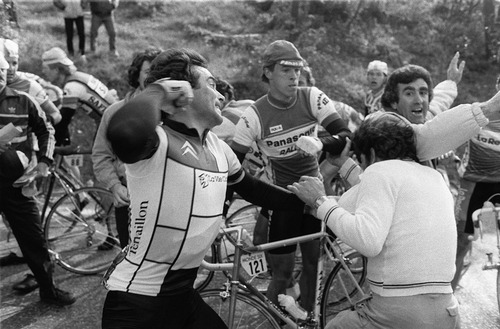
Bernard Hinault - aka The Badger - demonstrating the usefulness of street fighting skills in Paris-Nice.


Wednesday, April 11, 2012

Farnese: What's in a Name?

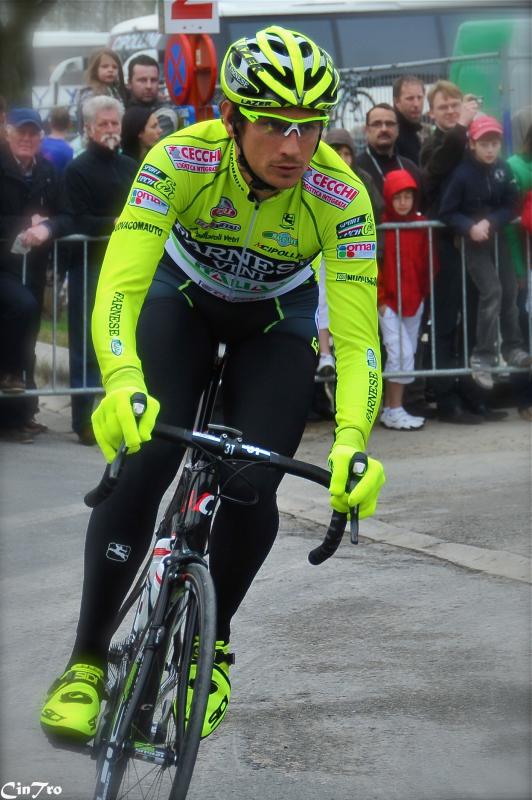
Most flahutes are still celebrating Tom Boonen's historic 4th win in Paris-Roubaix to equal Roger De Vlaeminck's record. But curious minds in Classiques Klassieker Classiche wonder why the name "Farnese Vini", the sponsor of the yellow glow team led by the unfortunate Pippo Pozzato, sounded so familiar to Low Countries history buffs.

Photo by Cindy Trossaert, under CC BY-NC 2.0.
Indeed, the name of the Farnese Vineyard the sponsor is the same name as that of Alessandro Farmese, Duke of Parma. And here is a short history of how the Duke's deeds in the low countries came to shape what we now know to be the Netherland, Belgium and Luxembourg.

Thursday, April 5, 2012

A Brief History of Pavé

Inspired by recent Tweets, we ponder to ourselves, from where do pavé blocks come from? How did these cobblestone sections come about?

Pavés of the Arenberg trench, likely made from sandstone.
Our first stop is obviously Wikipedia, where we learned that the term "cobblestone" is idiomatic. The root English word is "cob" which means "rounded". Thus "cobbles" roughly means "rounded lumps" or "large pebbles".

Indeed, back before the days of automobiles and carbon fibre bicycles, the fastest means of land transport is by horseback. The rounded shape optimized the speed of propulsion by means of a horses' hooves, and they were found to be quite sturdy in all sorts of weather even if they noisy and not the most comfortable for carriage-riding.

Friday, February 24, 2012

What Makes a Great Directeur Sportif?

What attributes make great directeurs sportif? In this post we cover a few traits that we think are essential attributes of legendary directeurs sportif that we respect.

Cyrille Guimard and protégé Laurent Fignon, riding a Cyfac under bike sponsor's paint job.

Tactical nous
This may seem obvious, but we claim that not all DS are good tacticians. It is one thing to bang on the side of the team car and threaten to run your rider over the edge of the Pyrénées, it is another thing to know just the right moment to attack, or the right moment to feint. To quote Lucien Van Impe, who credits his single Tour de France win to his DS telling him exactly when and where to attack, Cyrille Guimard truly is a man of dizzying tactical intellect. Headstrong Bernard Hinault perhaps explains Guimard best: "Cyrille Guimard does not listen to you, but in the races he is a tactical genius." Even the proud Laurent Fignon conceded, "With Hinault, Guimard already found a champion, whereas with myself, Guimard made a champion." Not only is Guimard a tactical genius, he is also a great scout of talent.

In fact, a deep look into the archives of Cyclingnews reveals that Lance Armstrong agrees (And consensus at the time was that Armstrong would definitely benefit from further tactical guidance). If you read French, an interview in which Guimard commented on Hinault, Fignon, LeMond, and even Andy Schleck is worth reading.

For a different side of Guimard, which may explain how he became a very accomplished DS, you can read our tribute to Guimard the Rider.

Tuesday, February 14, 2012

Rise of Nations

Just like in geopolitics, nations rise and fall as they contend in professional cycling. With the call for more and more globalization of pro cycling, we ask the question: what of the "old" nations and what of the "new emerging" nations?

In this article we use basic analysis tools to examine the rise and fall of nations in one-day racing. To be more precise, we consider Monuments and World Championship (WC) wins of Italy, Belgium, and France, versus those of "other nations." We use a moving-average of 7 years, which we consider the typical "mature and winning" period of a rider's career. We consider Milano-Sanremo, Ronde van Vlaanderen, Paris-Roubaix, Liège-Bastogne-Liège, Giro di Lombardia, Paris-Tours, and the World Championships.
What insights were we able to gleam? Read on ...

Thursday, February 9, 2012

Remembering Frank Vandenbroucke

It is hard to speak of Philippe Gilbert's breakthrough 2011 season without hearing echoes of Frank Vandenbroucke in the back of my mind. This post is not about Gilbert - we'll have plenty of opportunity to discuss him, his astonishing 2011 season, and his coming 2012 season. And verily, to Gilbert's great credit I think his character is nothing like VDB's.

But enough about Gilbert. This post is about the rise and fall of VDB, about why so many pinned hopes on him, and about how the level of idolatry by the Franky Boys grew to fever pitch.

To those of us who follow the classics, "VDB" as he was affectionately known was considered the Second Coming of Jesus. There are several reasons for his fans' unyielding fanaticism.

VDB riding a Cyfac under  Cofidis MBK's paint scheme. 


Friday, January 20, 2012

Cyrille Guimard The Rider: 1972 Tour de France

Today is the birthday of Cyrille Guimard. The genius of Cyrille Guimard as a team manager and directeur sportif is well-known. Here is the man who turned Lucien Van Impe into a Tour de France winner, guided the early career of Bernard Hinault, discovered Greg LeMond, nurtured Laurent Fignon, and arguably hired a younger Lance Armstrong  into Cofidis. At least, before Guimard was sentenced for credit card fraud. More recently, he managed the junior team Velo Club Roubaix that counted Andy Schleck in its roster.

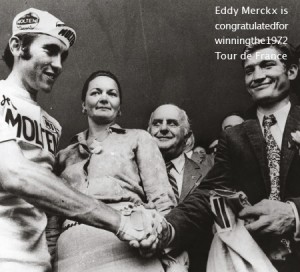
What is less-known to English-speaking readers is Guimard the Rider. This is a story of the 1972 Tour de France, and more precisely the battle of Eddy Merckx and Cyrille Guimard that will lead to the picture shown below.

Eddy Merckx and Cyrille Guimard at the TdF final podium in Paris, 1972.
Why is Merckx  in a cycling kit but Guimard is in a suit?

If that photograph had been in color, you will have seen that Merckx was wearing yellow and Guimard was holding onto a green-colored jersey.


Tuesday, January 10, 2012

Method to the madness, or how I learned about the classics (part 2)

Gentle readers, in Part 1 we learned about Liège–Bastogne–Liège, la Flèche Wallonne, and Paris-Roubaix. We learned that as many of the cobbled roads were converted to asphalt, the so-called Ardennes Classics LBL and FW took on more and more hills, whereas PR the Queen of the Classics, not so blessed with available hills along its route, took on what cobbled sectors remained and even added more and more "new" ones with passing years. It time now then to talk about the Tour of Flanders, de Ronde van Vlaanderen, or Vlaanderen Mooiste. 


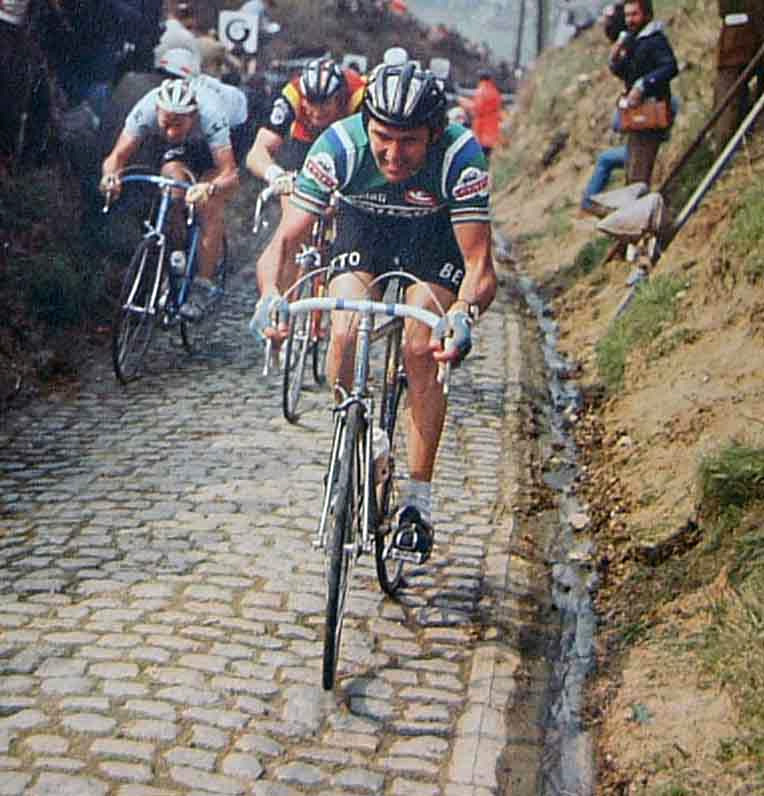
Photo from Wikipedia, Creative Commons License, due to Mick Knapton. 

Wednesday, January 4, 2012

Method to the madness, or how I learned about the classics (part 1)

Gentle readers, if you are reading this blog you are most likely already aware of what Paris-Roubaix is, perhaps of  Liège–Bastogne–Liège, and perhaps of the Tour of Flanders. But as soon as you delve a bit deeper beneath the icy surface of the Koppenberg, you find a whole other world of semi-classics such as Brabantse Pijl and Flèche Wallonne (which are really sister races, but that's another subject).


How does one possibly learn about these races, their significance, and how they relate to each other if one weren't born in a red barn-house in Belgium, and didn't learn to walk on Quick-Step laminated hardwood floors?

Allow us then to give a rambling tutorial of sorts, a story perhaps, of these races.