Monday, September 30, 2013

The One True Groupset

To celebrate Rui Costa's win in the World Championship, we offer the following tribute.

Fellow Brothers and Sisters in Campagnolo, let us pray. 

Dear Santo Tullio, since 2009 when Cuddles Evans won the World Championship thanks to his seamless multi-gear shifting up the final hill in Mendrisio, Swizzera, our faith surely has been tested. His win in the 2010 Giro d'Italia's muddy epic stage notwithstanding, was followed by the Great Twin Betrayals of BMC and QuickStep as they switched away from Campagnolo. 

We thank You for rewarding our faith last Sunday with the World Championship win of Rui Costa, of the Most Campagnolo Team of Movistar -- formerly known as Caisse d'Epargne, formerly known as Banesto, formerly known as Reynolds. 

Please guide your Apostle / Team Manager / Directeur Sportif Eusebio Unzué, who has guided Delgado, Indurain, Jiménez, Rodriguez, and Valverde, as he seeks to find new sponsorship for his team. May Unzué continue to be faithful to the One True Groupset. 

In the name of Santo Tullio, and His Son Eddy Merckx, and the Holy Delta Brakes we pray, Amen. 
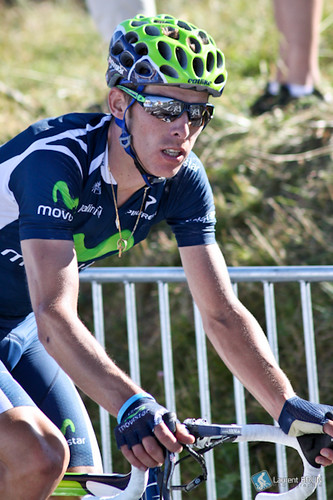
Photo by Petit Brun shared under by-nc-sa 2.0.

Friday, April 12, 2013

It's Go Time For Astana

Last year Team Astana v 3.0 delivered excellent performance in the Ardennes classics, with victories in Amstel Gold Race (AGR) and Liège-Bastogne-Liège; these wins were delivered by Italian Enrico Gasparotto and Kazakh Maxim Iglinsky.

The squad may forever be associated with the controversial Alexandre Vinokourov -- seemingly unrepentant doper but brilliant rider who recently won London Olympic Gold -- who remains as General Manager. However, today's Astana is equally the team of Team Manager Giuseppe Martinelli. He first became famous as the manager of Italian squad Carrera, which became Mercatone Uno as Claudio Chiappucci retired and Marco Pantani rose. From there he worked for Saeco, being the personal director of a young Damiano Cunego. Looking at his accomplishments as manager, it is clear that this is a man who knew how to win hilly classics and grand tours.

Maxim Iglinsky at the 2007 Tour de France.
Photo from Wikipedia Common, by McSmit (GNU Free Doc License 1.2).

This season's Team Astana v 3.1 added rising Italian star Vicenzo Nibali formerly of Cannondale. With a rising Peter Sagan and ever-popular Ivan Basso, Nibali moved to Astana partly to be his own grand tour contender. But Astana has proven itself with hilly classics contenders Gasparotto and Iglinsky.

In short, Nibali may have given up on classics ambition in order to pursue grand tours as a team leader. 

It is now up to Martinelli to use his squad to match their performance last year: don't forget that Nibali was second to Iglinsky in LBL, after a gutsy solo break that nearly succeeded. It will be too bad if Nibali were to give up on classics performance completely.

What's your prediction for Astana this year, will Martinelli's boys be able to step up to the challenge? Share your thoughts below.

Tuesday, April 2, 2013

Age and the Classics Contender

When Fabian Cancellara, Peter Sagan, and Jurgen Roelandts ascended the Ronde van Vlaanderen (RVV) podium last Sunday, we thought that it represented three generations of cyclists. Cancellara (RadioShack) is today 32 years old, Sagan (Cannondale) merely 23 years old, and Roelandts (Lotto-Belisol) is 27 years old.

We ask ourselves: How do classics contenders age?

Naturally, we went to Cycling Archives and explored the wealth of data to compare several notable cyclists of various era, and compare them to more recent heroes.

What of older heroes?

Thinking about the RVV we certainly thought of Briek Schotte (born in 1919), twice winner of de Ronde and one of the original hardmen. We then thought of Eddy Merckx (born in 1945) and his impossibly long list of victories. We also thought of Roger de Vlaeminck (born in 1947), a rival of Merckx. And of course Bernard Hinault (born in 1954) of a slightly younger generation much like Cancellara and Sagan.

We then plotted our perception of their accomplishment in classics races, versus their age. What we found was interesting.


Tuesday, March 26, 2013

Super Mario in Gent-Wevelgem

Peter Sagan's charismatic win in Sunday's Gent-Wevelgem was superb, sign of a true champion who knows when to take charge and when to push for the win. While many expected him to wait for the final sprint, he put in more than his fair share in a break of 13 riders, and left them all in the dust by attacking away. In the end, he had a 23-second advantage in a race that had been threatened with cancellation just hours prior.

His win reminded us of "Super Mario" Cipollini's three wins in Gent-Wevelgem: in 1992, 1993, and 2002. His first win was perhaps the most amusing one (Watch video starting at 1:55). What was to be a formality -- a field sprint -- had "Tashkent Terror" Djamolidine Abdoujaparov pull on Cipollini's seat post as Cipo was surging past him. The tug was enough to push Abdou ahead of Cipollini, however Cipo kept his cool and raised his arms in celebration anyway.

"I knew he'd get penalized," he said calmly.


Cipo's 1993 win was straightforward: he simply hit the gas and sprinted literally from the front, nobody was able to get around him.


Friday, March 15, 2013

Is Milano-Sanremo really a sprinters race?


In modern times this race has been billed as the "sprinters' classic," despite it having a series of sharp hills near the finish. This, after nearly 300 km of racing. Whether MSR comes down a field sprint is itself a difficult question to answer.

Curious to see whether and  how the sprinters' grip has strengthened, we look at whether the race ends in a sprint, starting from the 1960 edition to recent years. Which by the way, we don't view as having ended in a field sprint due to a very splintered front group. After some tweaking, we ended up with the following plot.

Does Milan-Sanremo end in a field sprint?

Thursday, March 14, 2013

The Roads to Milano-Sanremo

The latest freezing spell - blanketing snow on western Europe - had thrown a wrench into the preparation of many aspirants to the throne of Milano-Sanremo (MSR). It started with the change of day, from Saturday to Sunday. Suddenly, Belgium's little known Wednesday race the Nokere Koerse appeared to be the perfect last test before the lineup in Milan. Alas, snow forced cancellation of the event.

In previous post we have thought of how the pre-season, or early season, has changed. Which roads have the winners of Milano-Sanremo taken? We start with the latest, in 2012, when cheeky Australian Simon Gerrans won. He started his year with hard riding down under, including the Tour Down Under (TDU) and the various Aussie road races. Taking a break from racing, he resumed competition only in Paris-Nice (PN) on his way to victory.

Road to Samremo 2012.
On the other hand, second place Fabian Cancellara went to do the Tours of Qatar/Oman (TQO), then after some break from racing he went to Strade Bianche (SB), Tirreno-Adriatico (TA), and finally MSR. Third placer Vincenzo Nibali and fourth placer Peter Sagan, teammates in Team Cannondale, did nearly the same thing, although both skipped Strade Bianche. The fifth rider John Degenkolb did the harder route, from Qatar/Oman to Omloop Het Nieuwsblad to Paris-Nice.

Thursday, February 28, 2013

For Briek's Sake

I am just reminded again of the awesomeness of Briek Schotte.

It is so much so that 't Gaverhopke Brewery released a limited edition Koerseklakske.


If you don't know Briek, all you need to know is here:

I can tell you more about "de Briek" lunch menu at the cafe near the museum of de Ronde in Oudenaarde, it is simple pasta with brown sugar and nothing more. 

Briek died in 2004 on the day de Ronde was won by a German, in front of two Belgians! By eyewitness account, winner Stefan Wesseman's wife was sitting in a cafe/bar in Oudenaarde when this happened. The Belgian crowd boasted that the race was won when two Belgians and a German entered the finale together. As the German winner crossed the finish line first, the crowd grew hushed, the silence so deafening that Wesemann's wife left the bar in awkwardness. 

Damn, Briek must have died heartbroken. 

Lieve Vlaanderen! 

(*) Koerseklakske refers to the leather helmet cyclists had to wear in Belgium well before helmet rules were widespread. 

Thursday, February 21, 2013

Tour Down Under, Tour of Qatar, and the early season to de Omloop

Fans of the classics: as if the snow blanket of winter had lured us to complacency, the Omloop Het Nieuwsblad (OHN) is nearly upon us already. Hailed as the opener of the Belgian classics races (some other nations have had their opening races by then), we wonder the impact of emerging early season races in warmer climates on the OHN. More specifically, we wish to compare the importance of Tour of Qatar (ToQ) and Australia's Tour Down Under (TDU) on the performance of classics warriors who have done well in the OHN.

In order to do this, we made a list of wielrenners who finished in the top 5 of the OHN from 2008 to 2012 and empirically compute the correlation of their performance and their attendance at the TDU and ToQ. What are we able to find out? Read on.


Thursday, January 17, 2013

Belgian Succession

It is hard to believe, but Tom Boonen is aging. The Belgian boy wonder from east and north of Antwerp is already 32 years old, he may be at the peak of his prowess but he's ridden for 11 seasons. Just like his former mentor and teammate Johan Museeuw - whose career overlapped with Boonen's in near-perfect synchronous sequence - Boonen has become a much more focused rider than he was in his younger days. The overlap between the aging Museeuw and then-surging Boonen spoiled us fans in more ways than we realized then. We never had to look for a Belgian hero of the cobbled classics, for a new Lion of Flanders.

Tom Boonen in 2012, from Creative Commons under license CC BY-SA 2.0,
photo taken by Angelo Giangregorio.

This natural succession also benefited Patrick Lefevere's QuickStep team, who always had a popular icon to stand behind. Even in Boonen's leanest years of 2010 and 2011, when he merely won  Gent-Wevelgem and merely reached the podium in both editions of de Ronde. As we know, cycling is a team sport, therefore having such icons as Museeuw and Boonen helped the team secure sponsorship which in turn enabled the retainment of a royal retinue, a merry band of Belgians and Italians whose job security and raison d'etre revolved around those few sacred weeks in April.

Who shall succeed Tom Boonen as the Belgian kaseinfretter?

Tuesday, January 8, 2013

Can Old Dogs Learn New Tricks?

Several retired pros have gone on to have illustrious careers as team coaches and directeurs sportif (DS). Raphael Geminiani comes to mind: as a rider he won the King of Mountains jerseys in the 1951 Tour de France and Giro d'Italia, yet he is perhaps best remembered as the DS and team manager of the mercurial Jacques Anquetil. Not only was he the DS who could manage the tempestuous Anquetil to incredible feats, he was a business innovator who side-stepped restrictions on team sponsorship.


Monday, November 19, 2012

Classics talents and the grand tours

To lovers of the classics, one of the most frustrating aspect of being a fan is that we have to watch promising classics talents waste their potential by foregoing the classics in pursuit of General Classification (GC) glory in the grand tours. Countless riders have fallen into this pitfall, sacrificing their huge classics potential yet not quite succeeding in the grand tours.

With specialization become both more prevalent and deeper in recent years, we consider some active riders of today.


Tuesday, November 13, 2012

Patrick Lefevere and the Yellow Jersey: Unconsummated Lust

As the boss of OmegaPharma-QuickStep, and with his history in MG-GB, Mapei, and Domo-Farm Frites, it can be argued that Patrick Lefevere is one of the most successful among modern cycling managers. His riders have won every classic at least once, and their domination of the spring classics is so complete that longtime fans rue that too much time has past since his team's last 1-2-3 win in Paris-Roubaix. Add to this multiple World Cup wins, World Championships, and stage wins / jersey wins in the grand tours.

Patrick Lefevere, from Wikipedia Commons.

One glaring omission is that Patrick Lefevere has never won the general classification (GC) of the Tour de France (TdF). In this article we recall his various attempts to buy, grow, cajole GC champions for the TdF.


Wednesday, October 17, 2012

Champions in a Brawl

As the off-season of road cycling is suddenly upon us, our Classiciens ponder: How would cycling champions fare in a no-holds-barred brawl in a bar in Belgium? We celebrate the heroics of our hardmen on the bike, but who would they do in real-life situations that we Classiciens may have found ourselves in, once or twice?

Since much of this philosophical discourse is, well, philosophical and full of conjecture, we mix heroes of the old times, the not-so-old times, and of recent times. We start with a hypothetical bar, let's say at the foot of the Kappelmuur in Geraardsbergen, in the dead middle of February when snow and frost are still on the ground, and add a hypothetical cast of Henri Pelissier, Briek Schotte, Bartali and Coppi, Jacques Anquetil, Eddy Merckx, Freddy Maertens, Bernard Hinault, and of course Greg LeMond.

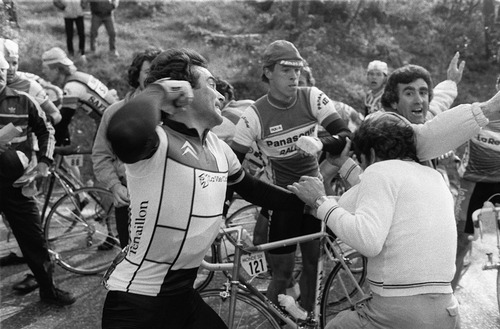
Bernard Hinault - aka The Badger - demonstrating the usefulness of street fighting skills in Paris-Nice.


Wednesday, October 3, 2012

What The Rainbow Misses in Paris-Tours


With a high-speed crash putting an end to Philippe Gilbert's chase of an exclusive Worlds-Lombardia double, Gilbert won't be showing up at the start line of Paris-Tours. It is too bad, because if he wins it he might be the first to ever accomplish the double of Worlds and Paris-Tours.

For a race that is officially considered a “classic”, Paris-Tours is perhaps the least prestigious among them—but that doesn’t mean it’s not important. Indeed, that it is absent from his list of 19 monuments and classics wins, Eddy Merckx cannot say that he’s won every classic.


Paris-Tours' first edition in 1896 was central France’s answer to Paris-Roubaix. The first edition followed a fairly flat course to Tours. Quickly it became known as the “Sprinters Classic”. In an effort to make it more interesting, derailleurs were banned for two years (1965 and 1966) and riders were only allowed two gears. Still, not content with what was thought to be a predictable finish, the organizers reversed the route in 1974, starting from the Tours area to somewhere in the vicinity of Paris. In 1988 the organizers decided to again reverse the route to start in Paris and end in Tours.

Thursday, September 27, 2012

The Rainbow in Lombardia

Philippe Gilbert (BMC)'s victory in the World Championship in Valkenburg heralded his return to winning ways. Following his two stage wins in the Vuelta a Espana, his blistering attack on the last ascent of the Cauberg opened a huge gap immediately and put the chasers into indecision. Now that he will be sporting the Rainbow Jersey for the next year, what other races are left for him to win this year?

Photo by corto.maltese, licensed under CC BY-NC-ND 2.0.

Fear not, for we still have Paris-Tours and Giro di Lombardia: both races he has won in the past. How will the Rainbow Jersey fare in these two races? Read our preview here and read on below for our history of the Rainbow Jersey and the fall classics.


Tuesday, September 25, 2012

The Italian Geometry

Have you ever wondered why certain bikes have that "special" ride? To many of us, our first great road frame was an Italian frame, probably made in the 1980s or 1990s. We asked Tim K, an avid collector and restorer of Italian bikes, what gave them that special ride: fast for crits but stable for long fast rides.

This is a guest post by Tim K, our resident expert on frame geometry.

From Channone, under CC-BY-2.0.

If you're talking pre-80's (like that Masi in my basement) then Italian geometry is actually very slack compared to an American bike from the same era.  Remember, Italy wasn't very well-paved until the 1980's, so a quick-handling bike would also be brutally uncomfortable, as well as dangerous.  So, angles tended to be a little shallower (around 72 degrees) and chainstays were quite long.  Fork rakes were around 50mm.  Bottom brackets were quite low.

These bikes have an exceedingly pleasant ride.  You can toot around town on them, go touring on them, or get in the drops and really start hammering, all by tweaking stem height a little.  They are not, however, particularly fast, since tons of pedaling energy goes into flexing the frame.

Monday, September 24, 2012

Komentaar: the 2012 Elite Men's World Championship Race

With one blistering attack on the Cauberg, Philippe Gilbert of Belgium opened up a mile-long gap from the front of the field in the 2012 elite men's world championship; effectively redeeming his 2012 season. We were impressed by the work of the Belgian team and of course by Gilbert's sense of timing. Despite having a different finale than the Amstel Gold Race route that the course borrowed heavily from, Gilbert bested our estimate that the Spanish armada would win by sheer weight of talent and history of teamwork. Had the Spanish bet on the wrong horse? Did team Italy work too hard in the middle part of the race? We share our thoughts below.


Monday, September 17, 2012

2012 World Championship Road Race Preview


The coming World Championship in the Limburg, the Netherlands, has parcours similar to the classic race Amstel Gold.  As usually the case, it is an attrition-style long course. While it is true that the course contains the dreaded Cauberg climb as it nears the finish - it can be a death knell for the ambition of many pure sprinters - it is hard to predict how the race will go.

For one thing, the distance from the final climb to the finish line is changed enough that we think it will have a significant impact that rouleurs might make it to the finish. Or even rouleur-like sprinters.


Read on as we share our observations and historical lessons from the last two times the race was run here.

Monday, September 10, 2012

What's In a Name? Mauro Santambrogio and Campione d'Italia

One of the most valued mountain domestiques today, Italian Mauro Santambrogio of Team BMC played a significant part in Cadel Evans' Tour de France win in 2011. Tirelessly he paced Evans up the Alpine climbs, often the only climber left in the team to help their GC leader.

From Gianluca Gozzolli, CC BY-NC-SA 2.0.

Just like many domestiques, Santambrogio rarely wins races on his own; but one victory in particular stood out, his win in Tre Valli Varesine in 2010. Finishing in the Alpine town of Campione d'Italia, Tre Valli Varesine is a great mid-summer race played out in the Italian alpine resort area.

Of course, what can't have missed what a great town name Campione d'Italia is: what's in a name? It is an exclave of Italy surrounded by Italian-speaking Switzerland that was ceded by Pope Julius II to reward the help of the Swiss back in the days. It stayed a part of Italy only because it was ruled by the Monks of Sant'Ambrogio in Milan, who then maintained their control of the town. Of course, that's the root of Mauro Santambrogio's name. We wonder if he celebrated this symmetry when he won that day in 2010.

Campione d'Italia: surrounded by Switzerland.

Campione d'Italia often hosts cycling races: the Giro d'Italia has held several stages there including time trials. Conveniently, it also hosts several casinos and use the Swiss Franc instead of Euros or Italian Lires back in the day.

So there you have it: Mauro Santambrogio and Campione d'Italia. What's in a name?

Wednesday, August 29, 2012

2012 Fall Classics Preview


With the end of the Tour de France and Olympic cycling competitions, we turn our attention to the Fall Classics, perhaps the lesser cousins of the Spring Classics. What races do we look forward to? We preview the World Championship, Il Lombardia, Paris-Tours, and discuss the issues plaguing GP Ouest France-Plouay, and fall classics in general.

World Championship in Limburg

World Championship in the Limburg, the Netherlands, has parcours similar to Amstel Gold.  As usually the case, it is an attrition-style long course. While it is true that the course contains the dreaded Cauberg climb as it nears the finish - it can be a death knell for the ambition of many pure sprinters - it is hard to predict how the race will go. For one thing, the distance from the final climb to the finish line is changed enough that we think it will have a significant impact that rouleurs might make it to the finish.

Or even rouleur-like sprinters.


Unlike in the Olympics, the top teams are allowed to field 9 riders for the Worlds elite men road race. Clearly the home Netherlands team would love to win this one, and they might just have the numbers for it if not a clear contender. Cavendish might like to be the designated leader for team GB again, but his team is not likely to have Bradley Wiggins on the roster. Team Italy has been unusually quiet, even though Damiano Cunego former winner of Amstel Gold might be quietly preparing for this race. Whether coach Paolo Bettini will select him as team leader is not clear.